

Why the US Needs A Clearly Defined War Strategy
The American military understands this even if the president does not

Editor’s Note:
This article was written by NSL4A member Tom Davis, a 1972 West Point graduate with a Master’s degree from Harvard University. He is author of the Cold War novels “Conclave” and “Empty Quiver.” This article was published April 11, 2026 in Medium. Into the second month of an elective war in the Persian Gulf, Davis dives into strategy and strategic education citing writings stretching from 19th century military theorist Carl von Clausewitz to more contemporary thinkers. Davis posits that “the American strategic and political objective has not been clear,” and that the administration has offered “numerous objectives for its Operation Epic Fury.” For all of the briefings and videos of things blowing up, Americans are still unsure of “what is to be attained by and in war.”
Tom Davis’ article was featured in the online publishing platform “Medium.” It is reprinted here with permission.
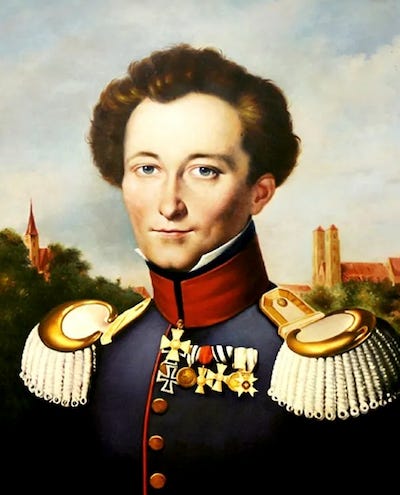
Carl von Clausewitz, photo Wikimedia Commons

Why the US Needs A Clearly Defined War Strategy
by Tom Davis
The American military institutions have always prided themselves on establishing a professional education system that systemically trains its officers from the Lieutenant-level, where they learn tactics, to the Colonel-level where they learn strategy. The late Colonel Harry Summers was one of the most acclaimed faculty members at the Army’s senior school, the Army War College at Carlisle, Pennsylvania, which focuses on strategy and strategic education.

The U.S. Army War College at Carlisle, Pennsylvania, photo U.S. Army.
While working in Vietnam after that most unfortunate conflict, Summers made a trip to Hanoi where he had a famous exchange with a North Vietnamese counterpart, a Colonel Tu. Over a relatively casual discussion about that war, Summers said to Tu, “You know, you never beat us on the battlefield.” Tu succinctly responded, “That may be so, but it is also irrelevant.”
Tu was correct, and his reply captured the essence of what a senior Army general who had served two tours in Vietnam as a junior officer once observed: “We never had a strategy for Vietnam, much less an executable one.”
After the Vietnam War ended in 1975, the U.S. Army along with its sister services began a period of great introspection. What went wrong in the conflict? Why did we invest so much treasure, at such great cost, for so little return? As part of that effort, the Army and the others re-discovered the lessons it had learned long before in the writings of a 19th century German military officer named Carl von Clausewitz.
The translations from Clausewitz’s classical German differ somewhat, but his most famous observation was, “War is nothing but a continuation of political intercourse with an admixture of other means.” A related observation was, “War is only part of political intercourse, therefore by no means an independent thing in itself.”
Clausewitz’s central point was that war had (regrettably) become one of several ways in which nation-states interacted with one another in the pursuit of perceived national interests.
But his major theme was, “War can never be separated from political intercourse, and if…this occurs anywhere…we have before us a senseless thing without an object.” In other words, war must have a strategic objective established by and understood by the political authority.
These erudite observations are reflected in the conversation of Colonels Summers and Tu. For the United States, Vietnam had become a tactical war lacking an achievable political objective. In his landmark book The Best and Brightest, Pulitzer Prize-winning author David Halberstam reported a discussion that retired General Mathew B. Ridgway had with President Lyndon Johnson and Vice President Hubert Humphrey following the Tet Offensive in February 1968. After Johnson had left the room, Ridgway asked Humphrey what was the mission assigned to the American commander in Vietnam, General William Westmoreland. Humphrey confessed he did not know and that it would be a good question to ask the president. Unfortunately for the curious Ridgway, Johnson did not return to the dinner to offer the answer — if he even had one.
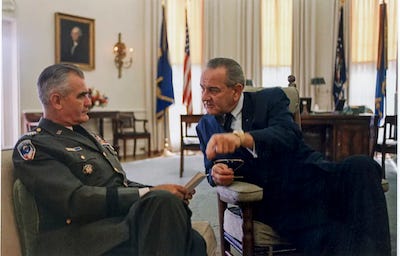
President Lyndon Johnson conferring with General William Westmoreland, photo Wikimedia Commons
But as Colonel Tu made clear, the North Vietnamese mission was a simple one: the North Vietnamese could lose the battles without losing the war. In essence this was the same strategy embraced by George Washington in the American Revolution. Washington did not have to defeat the British on the battlefield; he just had to make them sufficiently weary of the costs of the conflict to decide it was an unaffordable expense in manpower and treasure.
Which brings us to the current circumstance involving the conflict between the United States, Israel, and Iran. The American strategic and political objective has not been clear, and the tactical and operational expenditure of thousands of air attacks on thousands of targets has yet to provide a convincing clarification.
Instead, the administration of President Donald Trump has offered numerous objectives for its operation Epic Fury. It has implied it had the goal of regime change in Tehran; then of destroying the Iranian nuclear program — which it had previously claimed was “obliterated” in its twelve-day air campaign last June; then of destroying the ability of Iran to manufacture long-range ballistic missiles; then to destroy the Iranian navy and its ability to control the Strait of Hormuz; then to end Iran’s ability to fund hostile proxy forces throughout the region, such as Hezbollah in Lebanon.
As this strategic ambiguity has continued the tactical air campaign itself has proceeded unabetted. As of mid-April, the U.S. Central Command was reporting over 13,000 targets have been attacked, and the attack on military targets has been so large that air forces have turned their attention to Iranian infrastructure, with Trump at one point declaring the American bombers would next destroy all of Iran’s bridges and power plants, and even the Iranian “civilization” itself.
The press briefings at the Pentagon, frequently featuring video feeds of the air attacks and the explosive impacts of bombs hitting selected targets, have done little to lift the veil shrouding the strategic intent. Other videos and memes released by the administration have been similarly vacant, often leaving American and international publics with the feeling of seeing a computer game rather than receiving anticipated information.
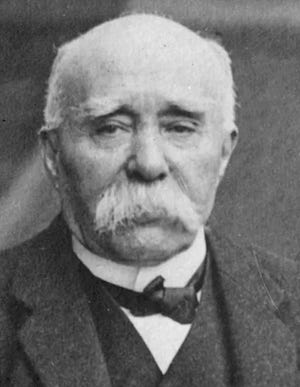
French Prime Minister Georges Clemenceau, photo Wikimedia Commons.
.jpg)
Georges Clemenceau, the French Prime Minister during World War I, famously quipped, “War is too important to be left to the generals.” Clemenceau’s concern was that military leaders might prioritize immediate tactical challenges over longer-term political and policy goals. It was a reasonable concern. But today, at least in the contemporary American condition, we may be struggling with the reverse. Whereas American military leaders are well schooled in the aged dictates of Clausewitz, American political leaders evidently are not. This would seemingly also apply to the political leadership of Israel, which itself seems increasingly prone to addressing near-term challenges without applying longer-term perspectives.
Some of this may reflect today’s quick pace of the internet-driven news cycle. Enormous amounts of often unfiltered information, frequently originating from questionable sources, is available at the touch of a cell phone button. For political leaders, managing the pace of this information, or disinformation, can result in a near-term focus at the expense of more distant objectives. This is a condition unfaced by either Clausewitz in the 19th century or Clemenceau in the 20th. It is clearly a burden for the modern political leadership. But it is one they must address because of another observation by Clausewitz: “No war is begun, or at least, no war should be begun, if people acted wisely, without first finding an answer to the question: what is to be attained by and in war.”
If that vital question is not asked, then as Clausewitz rightly predicted, the inevitable result was “a senseless thing without an obvious object.”

The Strait of Hormuz as seen from space, photo Wikimedia Commons.

M. Thomas Davis is a retired Army officer and corporate executive. He commanded a unit in Desert Storm and once served as Military Assistant to the Secretary of the Army. He was on the faculty at West Point and was an adjunct professor at Georgetown University. He is a graduate of the U.S. Army War College.
Voices of Experience offers timely analysis and seasoned insight from national security leaders committed to defending American democracy. Join us for clarity, expertise, and guidance through today’s complex national and global challenges. National Security Leaders for America (NSL4A) is a nonpartisan coalition of over 1,400 former senior military, diplomatic, and national security officials committed to upholding democratic principles and protecting the integrity of U.S. national security. Protecting the Constitution remains the mission, preserving America’s promise for future generations.