

Supporting the troops isn't the same as supporting the war
Funding can provide troops with what they need. It cannot substitute for deciding whether the nation should be at war or demanding a coherent strategy from the civilian leaders conducting it.


Editor’s Note:
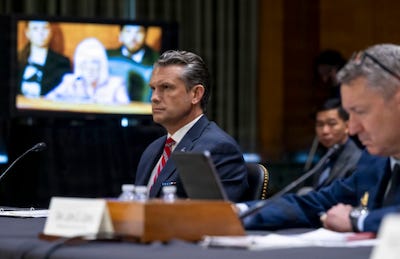
Defense Secretary Pete Hegseth and General Dan Caine, JCS Chairman, alongside Agriculture Secretary Rollins, appeared before the Senate Appropriations Committee on July 21 to speak in support of President Trump’s supplemental budget request. The hearing came as hostilities with Iran have escalated, war costs have jumped and service member casualties continue to add up. At points Hegseth became combative with Democratic senators who were critical of the planning and execution of the war. As the hearing wrapped up he shot back at Senator Gary Peters (D-WI) who had asked about a “lack of winning strategy.” Hegseth’s response conflated strategy with support for the troops, “Shame on you and others who call this a quagmire and a failure, and then you want to turn around and say you support the warfighter.
NSL4A member and communications director Dave Petri was watching and shared his insights and experiences in a USA Today op-ed where he is an opinion contributor. It was published on July 31, 2026.
Supporting the troops isn’t the same as supporting the war
That was Defense Secretary Pete Hegseth’s verdict on whether members of Congress support America’s warfighters during a contentious July 21 U.S. Senate Appropriations Committee hearing.
Yet senators from both parties had just demonstrated what responsible oversight requires: distinguishing the performance of American troops from the decisions of those who sent them into battle.
Democratic Sen. Martin Heinrich of New Mexico praised the “flawless” technical execution of American forces, while warning against confusing battlefield excellence with “long-term strategic success.”
Hegseth tried to seize on the word “failure.” He called criticism of the administration’s strategy “reckless,” said it smeared the troops’ sacrifice and accused Democrats of “political cowardice” for questioning an $87.6 billion supplemental funding request to support the Iran war effort.
His message was unmistakable: If Congress writes the check, it supports the troops. If it asks what the mission is, it does not.
The U.S. Constitution imposes a more demanding standard. It gives Congress the power to declare war, raise and support armies, provide and maintain a navy and control federal appropriations.
Those responsibilities are connected, but they are not interchangeable. Funding can provide troops with what they need. It cannot substitute for deciding whether the nation should be at war or demanding a coherent strategy from the civilian leaders conducting it.
‘Support’ doesn’t mean ‘no accountability’
One thing I learned as a Navy officer is that competent leaders prepare for difficult questions, provide candid advice and resist the temptation to blame others. During my naval career, the hardest leadership moments were not making difficult decisions, but admitting when I had made the wrong ones.
For example, during a routine at-sea operation, an order I gave caused an equipment failure that affected the ship’s propulsion. Taking responsibility meant documenting what happened for my chain of command, so others could learn from it.
The experience taught me that authority rests not on appearing infallible, but on responding candidly when decisions are questioned.
The recent Senate hearing offered a revealing contrast in how two senior leaders met that standard.
Air Force Gen. Dan Caine, chairman of the Joint Chiefs of Staff, often reflected that ethic during the hearing. He acknowledged that airpower has limits, and described his duty to provide the president with military options and their associated risks.
Asked whether the supplemental funding would be enough to finish the conflict, Caine conceded he could not predict the final cost because “the enemy has a vote.”
‘You’re with us or against us’ doesn’t sum it up
Hegseth offered a stark contrast.
Democratic Sen. Jon Ossoff of Georgia repeatedly asked the Defense secretary to reconcile previous declarations that Iran’s military had been destroyed, rendered “combat ineffective for years to come” and that “every single objective” had been achieved with the reality of an unfinished war.
Hegseth never directly answered. He returned instead to descriptions of a historic military campaign and lists of Iranian capabilities that American forces had destroyed.
When other senators questioned the strategy, he blamed the Biden administration or attacked their motives. That is not the candor, composure or accountability service members deserve from civilian leaders who send them into harm’s way.
Questions about the mission’s end state did not come only from Democrats. Republican Sen. Mike Rounds, of South Dakota, said when the nation sends young Americans into battle, leaders must “make sure that you get in, you get the job done and you get out.”
Observing “we haven’t finished the job,” Rounds asked whether the latest funding request would end the conflict successfully – or merely carry the administration forward until it returned for more money.
With service members still at risk, Republican Sen. Lisa Murkowski of Alaska questioned whether appropriating the requested funds might be viewed as a stand-in for explicit congressional authorization for the war.
These were not the questions of lawmakers indifferent to the troops. They were questions Congress must ask, precisely because American lives are at stake.
What is the political objective? What does victory mean? What conditions would allow the mission to end?
A complicated situation defies simplistic choices
The costs of failing to answer those questions extend beyond a budget. Ships like the USS Gerald R. Ford are experiencing deployments far longer than designed deployment lengths. Sailors and their families absorbed those additional months while the Navy assumed greater maintenance and readiness risks.
Moreover, today’s exposure to combat, noise and psychological stress will also become tomorrow’s obligation to provide veterans’ care and disability compensation.
Congress therefore has two responsibilities. It must ensure that troops already in harm’s way receive the protection, equipment, medical care and logistical support they need. It must also decide independently whether the military mission is lawful, justified and worthy of continuation.
By stating that “either you do or you don’t,” Hegseth presented Congress with a false choice. Supporting the military is not a binary decision between funding and abandoning the troops.
It is a choice to exercise the judgment necessary to ensure their mission is worthy of the sacrifice – and to honor our obligations to them both during and long after the fighting ends.
Published by USA Today on July 31, 2026
Dave Petri, a retired U.S. Navy commander, serves as the communications director for National Security Leaders for America.
"Clausewitz lays it down as one of the bases of his system that the first and most comprehensive of all strategical questions is to understand rightly what the war means to the people engaged in it, so as to measure the degree of national endurance upon which you may rely." "The Seven Years War," by Sir Julian S. Corbett, page 169. Published 1907. (Mr. Hegseth lacks a clear understanding of war. He seems to believe that his short time in the National Guard qualifies him to lead the United States military. Just the rambling thoughts of an old hermit. Hope I haven't upset anyone. )
Excellent. Well said, Dave. Thank you for providing a clear analysis documents Hegseth’s incompetence, and logical fallacies. The binary choice of fund or abandon demonstrates immaturity, self interest, and lack of strategic experience.