

Parade Strength
Pete Hegseth’s testosterone initiative exposes a Pentagon more interested in performing strength than building it

Editor’s Note:
Last week Defense Secretary Pete Hegseth announced in a video posted to his official “X” account a mandatory program for service members 30 and older to be tested for testosterone deficiency and offered treatment if found to have a low level. He said he wanted troops to be “strong resilient and capable,” while a Pentagon spokesperson said the program aimed to meet the demand for “maximum psychological and mental readiness.” NSL4A member and retired U.S. Space Force Colonel Bree Fram wrote a comprehensive rebuttal to the program in her Substack (@breefram).
Parade Strength
By Bree Fram
My first reaction was to make jokes.
After expelling transgender service members for taking hormones to be their best selves, the Pentagon announced mandatory screening intended to identify far more troops who might benefit from long-term hormone therapy so they too could become their best selves. Hegseth’s hypocrisy could sustain a full stand-up routine.
The jokes expose something deadly serious: Pete Hegseth is building a military around the performance of strength rather than the capabilities that make a force strong.
Secretary Hegseth has ordered mandatory annual screening for testosterone deficiency for every service member aged thirty or older. Younger troops may request testing. The memorandum promises that lessons learned from treating “Operator Syndrome,” including “targeted testosterone therapy,” will be applied across the force because they “directly optimize Warfighter readiness.” In the accompanying video, he promised troops the hormone levels needed to operate at their “absolute best” and stay on “the leading edge of lethality.” He branded it “The High-T Department of War.”
First off: hormone therapy is healthcare. For everyone.
When a service member has a medical condition, the military should diagnose it accurately and treat it well. Testosterone replacement therapy helps some patients with clinically established hypogonadism. Troops deserve excellent medical care. Full stop.
There are fair clinical questions here. The Endocrine Society recommends diagnosing hypogonadism from symptoms combined with consistently low lab values, and recommends against routine screening of the general male population. Stuart Phillips, a kinesiology professor and muscle health expert at McMaster University, told the Washington Post, “[a] blanket [policy], like, we’re going to screen everybody over the age of 30, is kind of a ridiculous notion.” The Pentagon has not released the clinical guidance that will govern how results are confirmed, when treatment is indicated, or how patients will be monitored.
Those questions matter. Answered correctly, they could produce a program that supports the endocrine health of every service member, including women. But the questions are not what stopped me cold.
When performance couldn’t justify the purge, prescriptions did
When this administration purged transgender service members, the case could not be built on our performance. We flew the aircraft, ran the networks, led the formations and met the standards. So it attacked our character—and turned our prescriptions into evidence against us.
We were told our ongoing medical care posed an unacceptable risk. That dependence on long-term medication compromised deployability. That our bodies required interventions incompatible with readiness. In February 2025, the Pentagon declared the “medical, surgical, and mental health constraints” of gender dysphoria incompatible with readiness, lethality, cohesion, and integrity. It ordered us separated and stopped funding hormone therapy.
The executive order behind the purge declared that troops must be able to fight “without the benefit of routine medical treatment.” Now read the testosterone memorandum with that sentence beside it: annual labs, ongoing prescriptions, monitoring. Routine medical treatment, rebranded as lethality.
Now the same Department wants a far larger share of the force screened for a condition whose treatment is long-term hormone therapy, and it is calling that treatment a readiness investment.
Testosterone replacement therapy is ongoing hormone medication. It requires regular lab work. It requires monitoring for blood clots, sleep apnea, prostate health, and fertility effects. It is, in every medical and logistical particular, the thing this administration told federal courts was disqualifying: a pharmaceutical dependence that follows you to the field.
Hormone therapy is a readiness crisis when a transgender captain takes it. Hormone therapy is a lethality program when the Secretary promotes it. Same molecule, in the case of transgender men. Same pharmacy. Same monitoring. For transgender women, estrogen may present fewer logistical complications because, unlike testosterone, it is not a controlled substance.
The medicine did not become more deployable. It already was. In my case, I could have deployed for a year, with my entire prescription barely noticeable in one pocket of my OCP trousers. The only thing that changed was the politics of who deserves to serve.
With Hegseth’s announcement, the Pentagon has again validated what transgender troops argued for years: needing regular medication does not make someone a readiness burden. A stable condition can be managed. A prescription can improve health and performance. Fitness to serve should be determined by whether you can do the job, not by whether a medication bottle is packed beside the body armor. We already do it for a wide range of conditions.
There is no coherent third answer here. If long-term hormone therapy inherently undermines readiness, the Department just designed a program to expose a significant portion of the force to precisely that risk. If it doesn’t, then the central readiness argument used to remove people like me has collapsed, in writing, over the Secretary’s own signature.
I’m a rocket scientist, and this certainly isn’t: it was never about the medication.
Standards for thee, not for me
This story isn’t only about transgender troops. We were the proof of concept.
Ask Admiral Lisa Franchetti, the first woman to serve as Chief of Naval Operations, fired without explanation in the administration’s opening weeks. Ask Admiral Linda Fagan, the first woman to lead the Coast Guard, dismissed before the inauguration confetti settled. Ask Rear Admiral Amy Bauernschmidt, the first woman to command a nuclear aircraft carrier, who was recently pulled from a promotion list. Ask General C.Q. Brown Jr., a fighter pilot with 3,000+ flight hours, star of the best recruiting video the Air Force ever made, and a career most officers would trade anything for, removed as Chairman of the Joint Chiefs after being labeled a diversity hire. His qualifications were never the question. The color of his skin was.
The Secretary told a roomful of generals exactly what he values: “It all starts with physical fitness and appearance.” Combat roles would be held to a male standard. Beards would no longer be authorized. Anyone unwilling to shave and look professional should find “a new position or a new profession.”
Appearance came first in his own sentence. That is not accidental.
Women have heard this definition of strength before. Hegseth questioned in print whether women belong in combat at all, then as Secretary decreed that combat roles be governed by the “highest male standard.” And when reporters asked whether the Department planned comparable attention to estrogen-related care for women, including the thousands of service members entering perimenopause while still deployable, the Pentagon offered no answer. Hormone health became a readiness priority the moment the hormones belonged to men.
I believe in demanding standards. I also believe standards must be connected to the work. If the job requires carrying a particular load a particular distance, test that. If it requires judgment under sleep deprivation, test that. If it requires flying an aircraft, repairing a satellite terminal, or defeating an enemy drone network, measure the skills that determine success.
A woman who meets the mission requirement has met the standard. A man who cannot has not.
Testosterone is not a substitute for competence, and masculinity is not a military occupational specialty.
Black men have also learned what happens when the Secretary’s image of a warrior becomes policy.
Pseudofolliculitis barbae, the chronic skin condition commonly called razor bumps, affects somewhere between 45 and 83 percent of men of African ancestry. The Army’s own medical guidance says the single most effective treatment is to stop shaving. Yet under the new grooming rules, permanent shaving profiles are prohibited, and prolonged medical exemptions can trigger review for separation.
There are real operational reasons to regulate facial hair. A beard can break the seal of a protective mask, and a service member facing a chemical threat must be able to use lifesaving equipment. That is a mission requirement: test the seal, and enforce the standard when and where the equipment demands it. Studies have shown that a short beard can maintain a seal with modern protective equipment, and many allied militaries permit them. Retired Navy Captain John Cordle has written extensively on this. Hegseth’s policy goes much further. It treats the clean-shaven face itself as the discipline.
Hold those two policies side by side. A Black man managing a documented medical condition with a short beard is a discipline problem who may be shown the door. A man beginning long-term hormone treatment because the Secretary believes it will make him more lethal is a readiness investment.
One medical need conflicts with the aesthetic, so it becomes insubordination. The other reinforces the aesthetic, so it becomes optimization. The beard is visible. The prescription is not.
This is not one standard for everyone. It is suspicion for people who look different and presumption for people who match the picture already hanging in the Secretary’s mind.
The parade has never frightened a competent enemy
Militaries have been confusing the image of strength with the substance of it for as long as they have held parades. History grades the confusion harshly.
In 1806, the Prussian army was the most admired in Europe. It had inherited Frederick the Great’s legend and spent the decades after his death perfecting his parade maneuvers: precision drill, immaculate uniforms, and an aura of invincibility. Napoleon met that army at Jena and Auerstedt and destroyed it in a single day. Prussia had rehearsed the appearance of strength for a generation. It collapsed in weeks.
Carl von Clausewitz fought in that campaign and was taken prisoner in the retreat. Writing later in On War, the closest thing military strategy has to a bible, he mocked the Prussian generals of 1806 for plunging “into the open jaws of destruction” by mechanically reapplying Frederick’s oblique order of battle, decades out of date. He called it “the most downright stupidity to which methodicism ever led.” The army could still perform the maneuver perfectly. No one had asked whether it still worked.
A century later it was French leadership that failed to ask. Their soldiers marched into the First World War in blue coats and brilliant red trousers. Proposals for less visible colors had died in parliament because heroes were expected to look heroic. “Le pantalon rouge, c’est la France!” a former war minister declared. France buried much of a generation learning a formidable appearance was no match for machine guns. The red trousers became a symbol of a military culture in which the appearance of courage survived after battlefield reality made it dangerous.
We know this pattern instinctively when we watch other countries perform it. We spent decades laughing at Pyongyang’s goose-stepping columns and Red Square’s rolling missile displays, and we understood exactly what those parades were: theater for the leader, decoys disguised as force structure, oppression dressed as capability.
Then Russia’s parade army rolled toward Kyiv in 2022 and stalled on a highway, a forty-mile column ambushed and turned around by a smaller force that had spent far less to be ready instead of looking ready. By this May, Russia’s Victory Day parade reportedly ran without tanks for the first time in roughly two decades. The parade army could no longer equip its own parade.
The parade, the performance of strength, is always for the man on the reviewing stand. It does not frighten a competent enemy.
Brute force meets a thinking adversary
Bring the lens down from armies to engagements and the record gets more specific. Strength that consists of confidence, mass, and image loses, again and again, to adversaries who think.
In 1866, Captain William Fetterman reportedly boasted that with eighty men he could ride through the entire Sioux nation. He rode out of Fort Phil Kearny with almost exactly eighty men, chased a small decoy party that included a young Crazy Horse over a ridge, and was dead with his entire command in minutes. He had all the martial confidence a man could carry. His enemy had a plan.
The counterexample is also American. A slim paperback, The Battle Off Midway Island, only 134 pages, still sits on my bookshelf. It’s torn, stained, and ready to fall apart because I read it at least six times as a child. It described the courageous seamen and airmen who would, “plunge into the midst of a raging battle that will leave two mighty nations changed forever.” Even a book that could be grasped by children knew to credit intelligent leadership.
In June 1942, six months after Pearl Harbor, Japan sailed for Midway intending to spring an ambush on the last American carriers. The plan depended on surprise. But cryptanalysts at Pearl Harbor had been reading fragments of the Japanese naval code and suspected the target designated “AF” was Midway. To confirm it, they had Midway radio in the clear that its freshwater plant had failed. Japanese traffic soon reported that “AF” was short of water. Admiral Nimitz positioned his carriers northeast of the island, and Japan sailed into the ambush it believed it was setting. The decisive Americans that morning included the pilots who flew into the flak, and also the linguists, mathematicians, and radio operators in a basement who put them in the right place. No fitness test would have identified them. No parade would have put them at the front. Brawn and physical endurance helped carry the day. Brains made it possible to win.
Sixty years later, the Pentagon spent $250 million on Millennium Challenge, the largest wargame in its history, to test the future force against a fictional Gulf adversary. In the story, reconstructed by War on the Rocks, retired Marine Lieutenant General Paul Van Riper, playing the enemy, refused to fight the American script. He moved orders by motorcycle courier to evade signals intelligence. He swarmed the fleet with small boats and a barrage of cruise missiles. In the simulation’s opening phase he sank an aircraft carrier and much of the American fleet, inflicting thousands of simulated casualties. “The whole thing was over in five, maybe ten minutes,” Van Riper said.
The Pentagon’s response is the part to remember. It did not absorb the lesson. It refloated the sunken ships, rescripted the exercise, and constrained Van Riper’s tactics until the American side could win. He resigned from the game in protest. Faced with a choice between learning and looking strong, the institution chose the look.
That instinct did not retire with the officers who indulged it. It is sitting in the E-ring right now, filming its workouts.
A day without space
There is one more wargame experience worth telling, and it comes from my world.
Years ago, the Department ran an exercise built around a deceptively simple condition: fight a high-end, thinking adversary on a day without space. The umpires switched off the satellites, the way a capable enemy would try to on the first morning of a real war.
The joint force stopped functioning.
Weapons had no precision. Navigation fell back to paper. Communications beyond line of sight went silent. Missile warning went dark. The synchronized, distributed, always-connected force that our doctrine assumes simply ceased to exist, and the exercise ground to a halt so completely that, in an echo of Millennium Challenge, the umpires had to turn space back on for the game to proceed.
No amount of warrior ethos rerouted a communications satellite. No fitness standard restored GPS. No testosterone level, however optimized, put missile warning back on line. The strength that kept the force fighting was invisible and unphotogenic: engineers, operators, orbital analysts, the people who build and fly and defend the systems that make the force lethal at scale.
I spent my career in that world, planning and designing the space capabilities the joint force depends on. I can tell you with professional certainty: the decisive service member on the next battlefield may be the one who analyzes intelligence, rewrites the software, understands orbital dynamics, or changes tactics before the enemy updates the countermeasure.
You cannot bench-press an algorithm. A drone swarm is not intimidated by your jawline. A network does not care whether the person defending it has a beard.
The future force needs brawn. Combat still requires it. But it needs far more than brawn. It needs linguists, analysts, maintainers, cyber operators, drone pilots, and leaders who make ethical decisions with incomplete information. It needs every mind capable of contributing to the mission. Excluding qualified women, burdening Black men over stubble, and expelling proven transgender troops does not concentrate strength. It shrinks the recruiting pool, thins the expertise, and makes the institution dumber and primed to fall into the next trap.
The appearance of a warrior
When I began my first Pentagon assignment in 2016, there was a “Pentagon Language Translation Guide” posted in my office. In one column was a list of phrases you might hear; in the other what the person really meant. If, in the middle of discussion, a point was questioned and you were told, “I would be willing to show you our detailed analysis,” you needed to buckle up because that meant, “Would you care for some public humiliation?” It was the ultimate expression that we valued brainpower: the people who could do the analysis, point out the flaws, and create better solutions.
Here is what actual strength looked like. It looked like the master sergeant who managed her medical condition, her family, and the entire maintenance schedule without anything slipping. It looked like troops on blood pressure medication doing hard jobs in hard places, because taking care of yourself and being ready were never opposites. It looked like officers who didn’t need to be the biggest, baddest person in the room because they were the most prepared person in the room.
Strength is standards applied evenly. Strength is the best person in the job regardless of what they look like. Strength is a military that spends its energy on being ready instead of appearing ready.
For twenty-three years, I performed. I deployed. I commanded. I helped build the space capabilities our warfighters depend on. I took the same medication through much of that service without becoming a burden to anyone. Then politics decided my prescription meant I could not be trusted and was not ready. They called it merit.
They were wrong then. Their own policy proves it now.
Testosterone may help some service members. If they need it, they should get it. But High-T does not substitute for low strategy. And a military that organizes itself around looking strong will eventually meet an enemy that measures the difference between performative masculinity and combat performance.
Last year, tanks rolled down Constitution Avenue on the president’s birthday. The spectacle was meant to project American power. But we had spent decades watching the same displays in Moscow and Pyongyang and understanding what they were for: not the enemy, but the leader on the reviewing stand.
We should not become the spectacle we once mocked.
The parade is for the leader. The battlefield keeps score in blood.
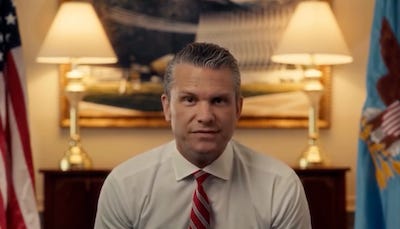
Screen grab, Secretary of War Pete Hegseth, “The High-T Department of War,” announcing DoD testosterone testing policy on X, Jul 15, 2026
Bree Fram is an astronautical engineer, public policy expert, speaker, former Congressional candidate, and retired U.S. Space Force colonel. She was forced to retire from the military in 2025 after 23 years of service due to Trump administration's policy regarding transgender people. She has published three books, including Forging Queer Leaders and With Valor and Visibility. She is a member of The Steady State and National Security Leaders 4 America.
Bree's story is a powerful reminder that military readiness is measured by competence, character, and mission performance—not by ideology or selective biological metrics. Her distinguished record and noted accomplishments demonstrates the expertise our nation can least afford to lose. Reducing years of exceptional service to a single characteristic ignores the very qualities the military depends upon: talent, innovation, and dedication to the mission. We should evaluate those who serve by their ability to protect the nation and uphold their oath to the Constitution, not by arbitrary standards that overlook proven excellence.
Great piece. There are some pithy lines in there. This is a not-so-veiled initiative to rid the military of what Hegseth believes are lazy brown-skinned people. It's not just blacks. Low-T is just a dog whistle for anyone who is lazy, which gets applied to Puerto Ricans and Latinos. Testosterone levels will be a disqualifier for those women who can meet male standards for things like a Ranger designation, or infantry officer school. It's so much more insidious than just some vision of a high-T military. Remember, Hitler gave meth to some of his troops thinking it would increase and sustain lethality....and more likely make them do things they would otherwise not do in armed conflict.