



Editor’s Note:
This article was written by former U.S. Army Brigadier General Greg Smith, who served 35 years in uniform. It was published April 29, 2026 on “Paul’s Substack - Dispatches from a Dangerous World.” In it, Smith, an instructor in Counterterrorism Strategy at Nichols College, questions the, as of this month, 58 attacks in the Caribbean and eastern Pacific, on alleged narco-traffickers resulting in 190 deaths, including two killed September 2, 2026 in a deliberate second strike. Smith examines the official definitions of terrorism and concludes, “They may very well be criminals, but their activities do not meet the definitions of terrorism.” He goes on to express concern about the reputation of American military members, “the Good Guys,” in an era where kinetic strikes such as these call into question the legitimacy of the use of force.
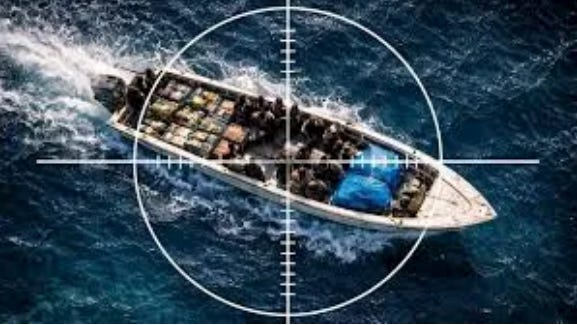
Counterterrorism or Summary Executions
By Paul “Greg” Smith
Counterterrorism or Summary Executions?
On 5 May, 2026, US Southern Command (SOUTHCOM) released the following statement accompanied by a grainy video:
“On May 5, at the direction of the commander of U.S. Southern Command Gen. Francis L. Donovan, Joint Task Force Southern Spear conducted a lethal kinetic strike on a vessel operated by Designated Terrorist Organizations.
Intelligence confirmed the vessel was transiting along known narco-trafficking routes in the Eastern Pacific and was engaged in narco-trafficking operations.
Three male narco-terrorists were killed during this action. No U.S. military forces were harmed.”
Since September 2025 SOUTHCOM has conducted lethal strikes against boats that are suspected of drug trafficking. The initial justification was that these boats contributed to the fentanyl infestation from Venezuela that was responsible for widespread US overdose deaths. However the Council on Foreign Relations reported, “.. fentanyl itself is not produced or widely consumed in the Latin American country.” Nevertheless it appears that many of these boats were illegally transporting cocaine.
On 2 September 2025 a US Navy vessel struck a boat suspected of drug trafficking. Forty-one minutes later the US vessel launched a second missile that killed two individuals clinging to the wreckage from the initial strike. The survivors reportedly were unarmed and defenseless. The Department of Defense deflected requests for the public release of video footage citing classification issues. Republican officials dismissed allegations of wrongdoing although there were many concerns that the “double-tap boat strike” was a summary execution that constituted a war crime.
The debate that raged over the September 2, 2026 two-stage boat strike raised further questions about the overall legality and morality of the SOUTHCOM boat strike campaign.
The most recent strike was the 58th action that SOUTHCOM has executed against a small boat in international waters. The three men killed this month brought the death toll to over 190.
Troubling Questions
The brief statement about the 5 May 2026 SOUTHCOM boat strike raises more questions than it answers.
To what Designated Terrorist Organization did these men belong?
Is there any additional proof of criminality other than “the vessel was transiting along known narco-trafficking routes?”
How did SOUTHCOM determine that the men were “engaged in narco-trafficking operations?”
Were these men armed? Did they pose a threat to US forces?
SOUTHCOM has been less than transparent in explaining its standard operating procedures when approaching a suspected drug trafficking boat, which raises additional questions.
What actions are taken by US vessels when a suspected drug trafficking boat is identified?
Are messages broadcast or warning shots fired before lethal action is taken?
Are legitimate attempts made to disable boats, apprehend suspects, and prevent loss of life?
Perhaps the most troubling question is whether or not the deceased individuals were terrorists, suspected criminals, or unfortunate fishermen.
Terrorists or Criminals?
We’re unlikely to know if the individuals killed in the boat strikes were fishermen or narcotics traffickers, but the distinction between suspected criminals and terrorists is worth examination.
The Federal Bureau of Investigation (FBI) defines terrorism as:
“The unlawful use of force or violence against persons or property to intimidate or coerce a government or civilian population in furtherance of political or social objectives.”
The Department of Homeland Security (DHS) defines terrorism as:
“a premeditated threat or act of violence, against persons, property, environmental, or economic targets, to induce fear or to intimidate, coerce or affect a government, the civilian population, or any segment thereof, in furtherance of political, social, ideological, or religious objectives.”
While people targeted by US strikes in the Caribbean or Eastern Pacific may be involved in narcotics trafficking, there is no indication that these people have any religious, ideological, political, or social motivation. They may very well be criminals, but their activities do not meet the definitions of terrorism.
As suspected criminals the boat occupants are subject to apprehension, detention, and adjudication. But summary execution as a legal penalty for suspected narcotics trafficking is inconsistent with US and international law. In fact, President Trump has issued pardons for at least five high profile individuals - Juan Hernandez, Garnett Smith, Larry Hoover, Ross Ulbricht, Michael Harris - all of whom were convicted of drug trafficking crimes by US courts and sentenced to imprisonment.
Haley Fuller, writing for Military.com, offers this additional analysis about the use of military force against individuals:
“A recurring issue in modern conflicts is the tendency of governments to apply labels such as “terrorist,” “criminal,” or “narco-terrorist” to justify the use of military force. International humanitarian law does not recognize these labels as substitutes for legal analysis. Targeting decisions must be based on objective facts about an individual’s function and conduct at the time of attack, not on political characterizations.”
What Happened to the Good Guys?
For many of us in the US military community, the extrajudicial killing of suspected criminals in the SOUTHCOM area of operations is deeply troubling.
Years ago I served as an advisor in the SOUTHCOM area of operations where I trained military forces in a nation that had recently emerged from a brutal dictatorship. Our team’s task was to develop a United Nations Peacekeeping company that would serve as a model for the modernization of the army. Before we addressed any tactical skills, our first block of instruction with the unit’s leaders was respect for human rights and rule of law. In fact, this was a topic to which we returned often as we developed the UN force. We were also keenly aware that we had to “practice what we preached” during our off-duty conduct while in the host nation.
When I addressed academic or civilian forums in the host nation I was often confronted by examples of past US assistance to repressive South American dictators during Operation Condor in the 1970s and 1980s. I responded by explaining that the US military is able to learn from past mistakes, make corrections, and set a new course. I don’t know how I could instruct and advise about respect for human rights and rule of law while defending the current SOUTHCOM boat strikes.
Several weeks ago I was cleaning out my barn. I uncovered an old hooded sweatshirt that used to be a favorite. Across the chest it said, “God Bless the Good Guys,” and underneath were the seals of the five armed services (there was no Space Force then.) I looked at that sweatshirt for a long time. Then I carefully hung it up and hoped that some day I could wear it again.

Paul “Greg” Smith. Former US Army Brigadier General with 35 years in uniform. Commanded at every level below division, including military JTF command during the 2013 Boston Marathon Bombings. Current instructor in Counterterrorism Strategy at Nichols College. Paul’s Substack
Voices of Experience offers timely analysis and seasoned insight from national security leaders committed to defending American democracy. Join us for clarity, expertise, and guidance through today’s complex national and global challenges. National Security Leaders for America (NSL4A) is a nonpartisan coalition of over 1,400 former senior military, diplomatic, and national security officials committed to upholding democratic principles and protecting the integrity of U.S. national security. Protecting the Constitution remains the mission, preserving America’s promise for future generations.
A very thought provoking article. Think I will read it a second time. Thank-you for posting it. Just the rambling thoughts of an old hermit.